CPIM investigates integrated technologies that connect circuits, communication, sensing, packaging, and computation—from transistor-level design through measurement and system demonstration.
Analog & Mixed-Signal Integrated Circuits
We develop energy-efficient analog and mixed-signal circuits for sensing, data conversion, communication, and intelligent edge systems.
- Data converters and mixed-signal interfaces
- Sensor readout and signal-conditioning circuits
- Low-power analog and RF building blocks
- Silicon implementation, testing, and characterization
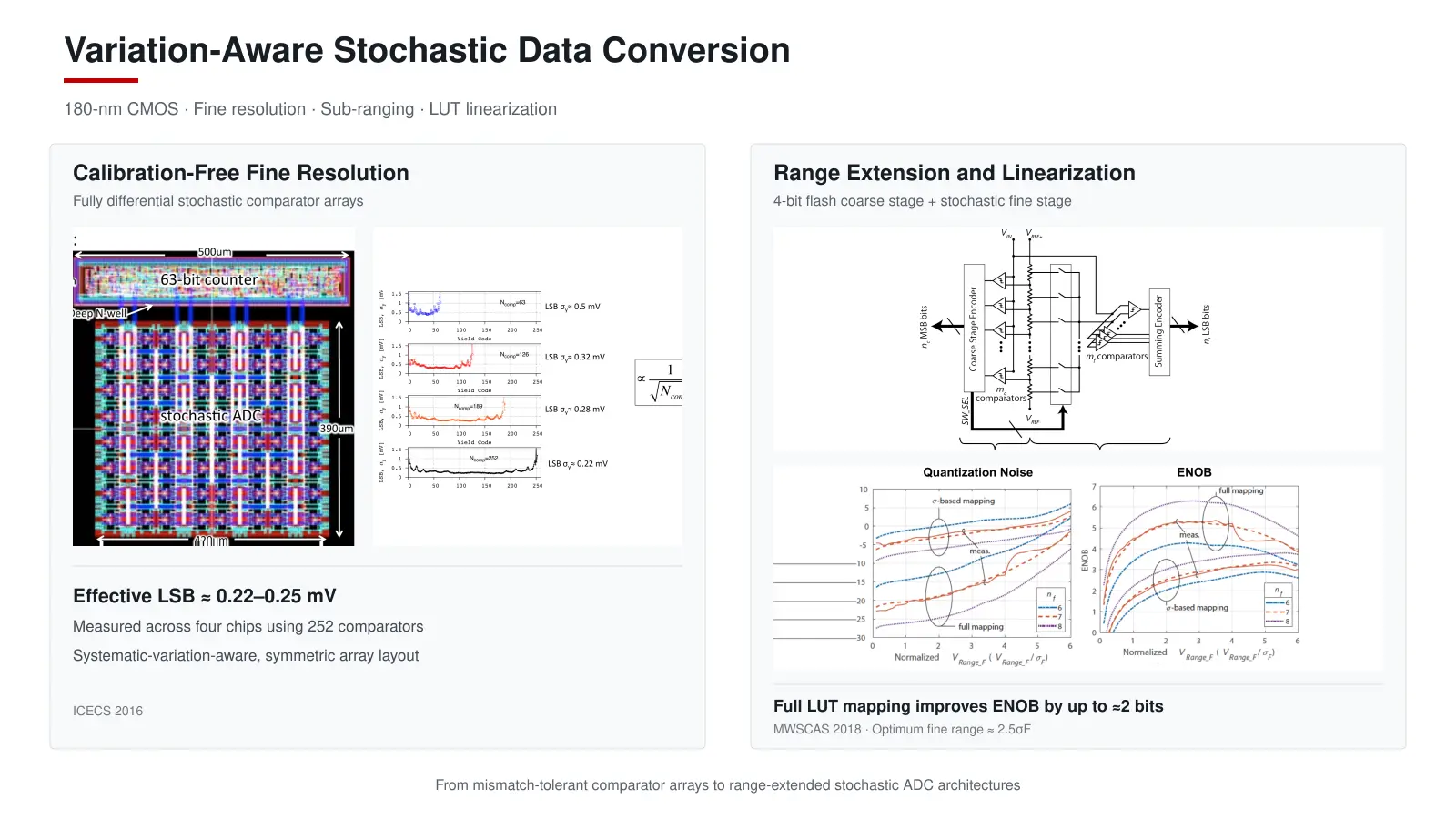
Variation-Aware and Stochastic Data Converters
CPIM research explores data-converter architectures that use device mismatch statistically rather than treating it solely as an error source. Prior work demonstrated fully differential stochastic comparator arrays in 180-nm CMOS with an effective LSB of approximately 0.22–0.25 mV, followed by a sub-ranging stochastic ADC employing a flash coarse stage and LUT linearization to extend input range and improve ENOB.
RF, mm-Wave, and THz ICs & Antennas
Our research explores high-frequency integrated circuits and antennas for communication, sensing, imaging, and chip-to-chip connectivity.
- RF/mm-wave/THz transmitters, receivers, and pulse transceivers
- On-chip, on-package, and on-glass antennas and arrays
- Near-field and far-field antenna characterization
- High-frequency measurement techniques and test structures
Advanced Packaging & Heterogeneous Integration
We study communication and co-design techniques that integrate multiple chips, packages, antennas, and technologies into scalable systems.
- Chiplet-to-chiplet communication
- Package-aware circuit and electromagnetic co-design
- Heterogeneous integration and high-speed interconnects
- Glass-based antennas and passive structures
Intelligent Microsystems
We combine custom hardware, embedded systems, and data-driven methods to create intelligent sensing platforms for real-world applications.
- Multimodal biomedical and environmental sensing
- Embedded systems and FPGA-based prototyping
- Edge AI and hardware-aware signal processing
- Connected sensors for health, agriculture, and infrastructure
Our Research Approach
DESIGN · BUILD · MEASURE
CPIM students connect theory with implementation through circuit design, electromagnetic simulation, fabrication, measurement, system integration, and technical communication. Our projects are structured toward tangible outcomes: paper · chip · prototype.